




Diplomatic Martyrs Memorial Design Competition – Circle of Memory
Memory, Nature, Threshold
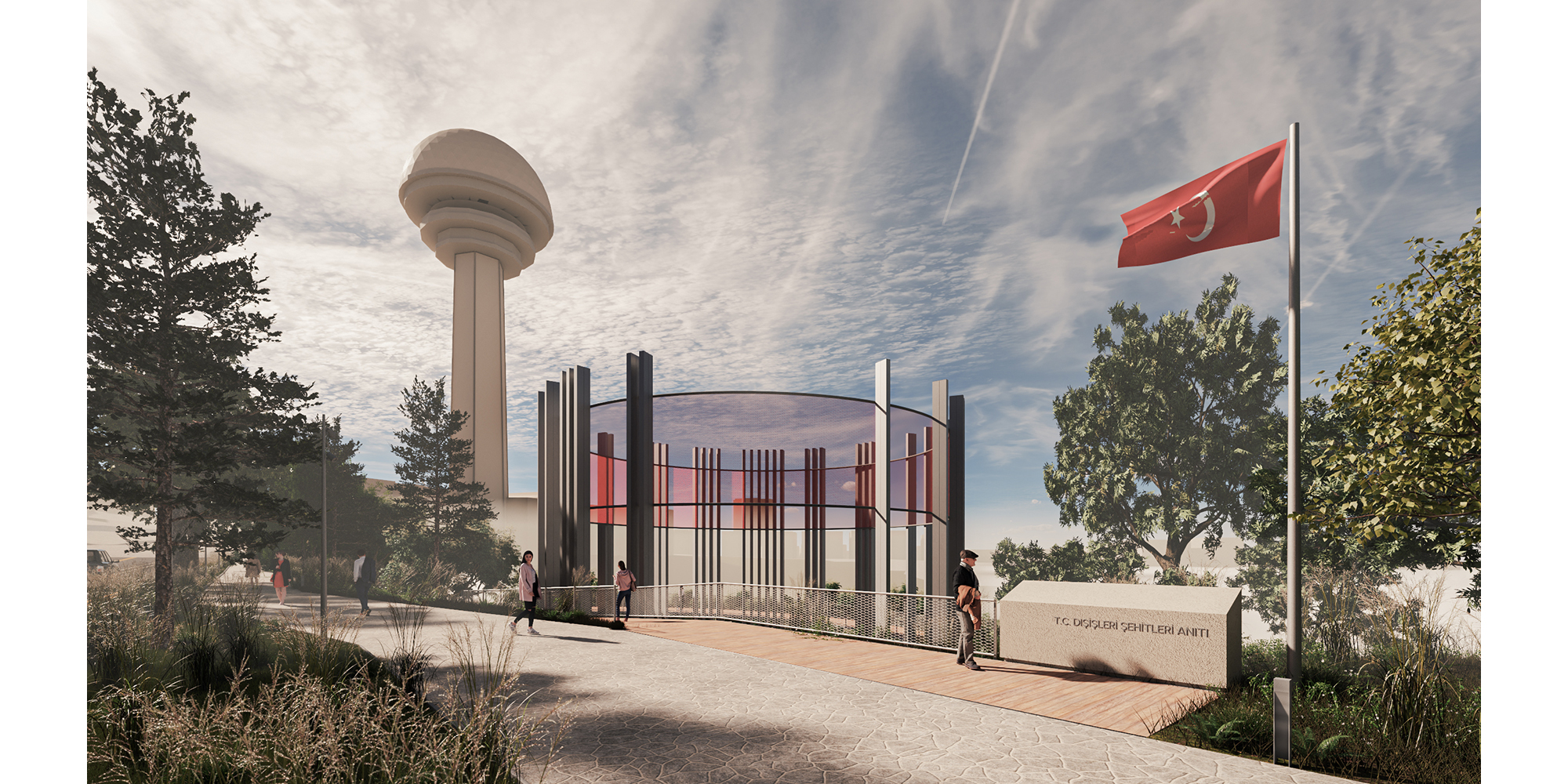
This commemorative space, integrated into the green layers of the Botanical Park, transforms a threshold in Ankara’s natural and cultural memory into a site of remembrance, creating a new cultural layer within the continuity of nature.
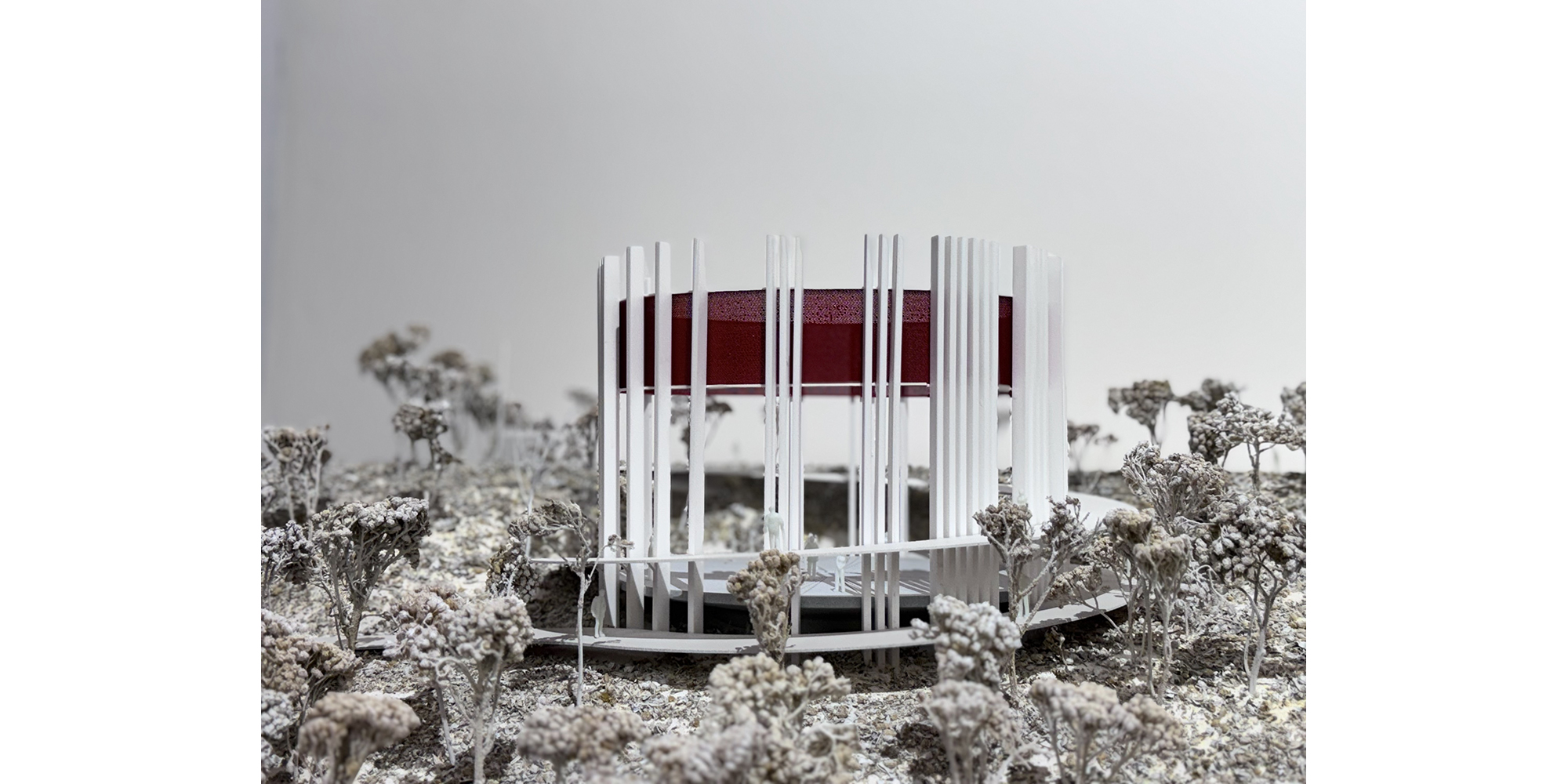
The design becomes more than a new main entrance to the park; it turns into a living part of the city’s collective urban memory. Each pillar represents a lost individual, while the clusters of pillars reflect the temporal intensities of losses spread over the years. This rhythm conveys both the silent trace of grief that unfolds over time and the undulating memory of history.
As the visitor descends gently via the ramp, they engage with the names of the fallen, confronting individual losses, while simultaneously witnessing the eternal cycle of nature and humanity through the panoramic views opening onto the Botanical Park. This dual experience—unfolding along the descent—offers a contemplative journey balanced between the weight of remembrance and the lightness of nature.

At the center of the space, collected water comes to life as it flows in fine lines from each pillar. This water stands as a response to violence and division; it is a symbol of healing, unity, and timelessness in the face of ultranationalist hatred. Flowing in an infinite loop, it honors the lost while marking the continuity of life and peace.
The Foreign Ministry Martyrs Memorial does not divide nature but makes room for memory within it.It becomes a memory stop opening to the city, forming a quiet yet powerful bridge between history and nature.
Urban and Natural Context
A Place of Memory within Ankara’s Green Spine
Green corridors, urban continuity
The foundations of today’s Atatürk Boulevard were laid with the 1924 Lörcher Plan, which envisioned the ideal city of the new Republic. In the 1928 Jansen Plan, a system interwoven with greenways, parks, and vegetable gardens was designed; Atatürk Boulevard was transformed not only into a transportation axis but also into a “green spine” that cuts through the city from north to south. In addition to green corridors along transportation routes, the plan proposed large public spaces, natural valleys, and parks that would later be referred to as “green belts.” Botanical Park is both a continuation of the Atatürk Boulevard green axis and a key connector to the Dikmen Valley green corridor.

The memorial site is located at the southern end of this historic spine, between Çankaya Street and Cinnah Street. Its proximity to the Çankaya Presidential Mansion and foreign embassies gives the site not only a natural but also a cultural and diplomatic significance. This transforms the space into more than just a park entrance; it becomes a threshold that sustains urban memory and adds a new layer to the national remembrance.
With its rich biodiversity and distinct landscape character, Botanical Park is not only an ecological zone but also a vital component of Ankara’s cultural landscape. The memorial design strengthens this continuity without disrupting it, forming a new bridge between nature and culture, individual memory and collective remembrance.

Natural Structure and Microclimatic Guidance in Design
A Silent Walk within the Ecological Continuity of the Valley
Valley form, topography, climate
Botanical Park is located on one of Ankara’s highest elevations, nestled within a unique topography shaped by a natural valley form. This geomorphological structure offers a terraced landscape experience along the north-south axis and supports microclimatic diversity.
Thanks to the valley formation, humidity levels in this area are higher than in the surrounding environment, allowing for a rare ecological richness in Ankara’s typically arid climate. The competition site follows this natural flow with a similar terracing: it transitions from the urban edge along Çankaya Street at the upper level to the lush greenery of the park at the lower level. These thresholds provide both physical and perceptual transition experiences along the gently sloping ramp.

The plant life ranges from native Anatolian flora to exotic species.With seasonal changes in color and texture, the memorial harmonizes with its natural context through continuous transformation. This evolving landscape offers not just aesthetic richness, but also reminds us that memory is a layered and changing process over time.
The natural topography and ecological diversity have guided both the physical layout and conceptual approach of the design. The memorial refrains from treating nature as a backdrop; instead, it turns nature into the very carrier of memory.
Memory, Flow, and Silence
A Space for Unity, Timelessness, and Healing
Conceptual framework, memory space, symbolism of water
The memorial design aims to create a memory space integrated with nature. Harsh geometries are avoided in favor of a soft spatial language that conforms to the natural topography. Starting from Çankaya Street, an accessible ramp gently guides visitors into the valley of the park, allowing them to establish a deepening connection with time, memory, and nature at each step.
The pillars symbolize each lost life. Their clustering by year reveals a rhythmic flow of historical accumulation beyond individual losses. The descent presents a memory experience that intensifies over time—inviting the visitor to face the past while embarking on a reflective journey within the unchanging flow of nature.
The circular arrangement of the pillars and the water element at the center of the space emphasize unity and the infinity of time. Thin lines of water flow down from each martyr’s pillar and converge in the central square of the memorial. This convergence symbolizes the gathering of personal grief within collective memory and the hope for healing. Here, water is not merely a physical element—it is a symbol of recovery, unity, and timelessness against violence and extreme nationalism.

The design language avoids monumentality and instead creates a simple, quiet, and powerful atmosphere. Without directing the visitor, the space offers an open field where each individual can undertake a personal emotional and intellectual journey.
Memory, flow, and silence merge in this space to create a lasting experience.
Spatial Setup: Visitor Experience
A Walk That Leaves a Trace: From Ramp to Ceremony Plaza
Pathway, descent, viewpoints
A subtle square and change in pavement texture along Çankaya Street draws visitors into the space. From here, the sloping ramp offers a rhythmic descent from urban density into the quiet of the natural landscape. More than a physical descent, this journey leads the visitor through a temporal experience.
At each turn of the ramp, panoramic views open onto the Botanical Park. These views create a poetic contrast between the permanence of nature and the transience of human memory. While confronting the past, the visitor also witnesses the infinite cycle of nature.

At the end of the descent lies the ceremonial plaza—a space for both gathering and contemplation. In this area, where the waters dripping from the pillars converge at the center, a quiet sense of infinity is created. The surface of the central water body unites memories flowing from the past to the present—holding together memory, time, and nature.
The visitor’s experience is left to the natural rhythm of the space. Without guidance or imposition, each person embarks on this journey at their own pace and emotional depth.
Materiality and Atmosphere
Natural Textures That Age with Time
Material language, textures, weathering
The materials chosen for the memorial are as modest as the relationship it forms with memory and nature. Far from being harsh or exaggerated, they are natural, weather-resistant, and harmonious with the climate and surroundings.
The ramp is clad in natural wood, bringing the warmth and texture of nature into the space. These surfaces do not disrupt the continuity of the landscape and provide a tactile ground that connects the visitor with nature.

The pillars are made of galvanized steel with a matte finish. These elements stand with quiet strength while establishing a delicate dialogue with the verticality of surrounding trees. The interplay of light and seasonal shadows lends a living face to the space.
The commemorative plaza is paved with brushed natural stone, textured with shallow water channels engraved into its surface. These channels silently guide water to the center of the space. Reflections of the sky, the flowing lines of water, and the central pool do not form a fixed object but offer an ever-changing experience. The clarity of the water and gentle ripples on its surface bring a sense of calm and timelessness to the space.
Landscape interventions are minimal and respectful of the existing diversity and design of the Botanical Park.
All material and atmospheric choices create a ground that allows the visitor to think, feel, and remember—gently and without force.
Conclusion
From Memory to Eternity
Eternity, remembrance, peace
The Foreign Ministry Martyrs Memorial establishes a silent flow that carries individual losses into the infinite cycle of collective memory. Each name, each step, each drop of water converges in unity toward a shared future.
This commemorative space is neither trapped in the past nor indifferent to the future. Within the continuity of nature, it becomes a pause that heals loss and weaves together the layers of time.

Designed to match the cultural and diplomatic significance of Çankaya, the memorial is a place of remembrance that respects the natural topography and ecological continuity.
It aims to foster reflection on loss, connection with nature, and belief in a common future.
In every step, every pillar, and every drop of water—the shared voice of loss blends into the eternal cycle of life. Thus, this space exists not only to remember the martyrs, but also to recall peace, solidarity, and the healing power of memory.
Info
Location: Çankaya, Ankara, Türkiye
Client: Ankara Metropolitan Municipality
Team: Y. Burak Dolu, Merve Torlak, Koray Bayraktutan, Saleh Malek, Kutay Şengöçmen, Osman Kongul, Zeynep Kılıç
Project Date: 2025
Land Area (m2): 900
Type: Competition
Program: Monument, Public Space
Scope: Concept Design
Photograph: Merve Torlak
Gallery


Project Location
KOOP Architects
Şahkulu Mahallesi,
Kumbaracı Yokuşu, No:57, D:5,
Beyoğlu / İstanbul / Türkiye
Al Tayseer Street, No 67, Flat 403,
Al Ain Central District, Abu Dhabi, UAE